Indonesia has not settled its biodiesel blend for 2027. On 12 November 2026, at the Indonesian Palm Oil Conference in Bali, Eniya Listiani Dewi, director general of new and renewable energy at the Ministry of Energy and Mineral Resources (ESDM), said next year's rollout must be checked for technical readiness, feedstock supply and financial risk, according to JawaPos. She told the audience, in the paper's translation, that she still had one month.
The stakes sit on two sides of the same barrel of crude palm oil (CPO). Palm oil that goes into diesel at home is not available for export, and the gap between biodiesel and fossil diesel prices is paid from a levy on palm exports. A higher blend raises both pressures at once.
Where the B50 rollout stands
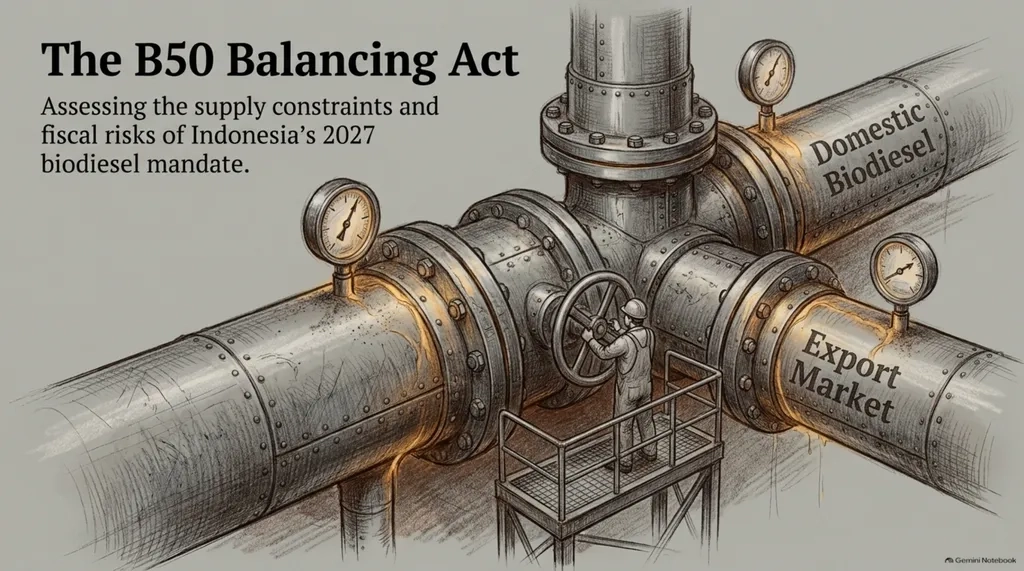
ESDM data show how fast volumes have grown. Distribution reached 10.69 million kiloliters (kl) by 7 September 2026, made up of 7.273 million kl of B40 from January to June and about 3.4 million kl of B50 from July, CNBC Indonesia reported from a hearing in parliament's Commission XII. By November, JawaPos reports, cumulative distribution was 13.84 million kl, about 83% of a 16.75 million kl allocation. The initial 2026 allocation set in December 2025 was 15,646,372 kl, per ESDM. The sources do not say whether the higher total reflects a revision.
| Indicator | Figure | Date or period | Source |
|---|---|---|---|
| Biodiesel distributed | 10.69 million kl | To 7 September 2026 | ESDM via CNBC Indonesia |
| Biodiesel distributed | 13.84 million kl (about 83% of allocation) | November 2026 | JawaPos |
| Projected FAME supply | 16.8 to 18 million kl | Full year 2026 | ESDM via Kontan |
| Estimated fossil fuel saving | 310,000 barrels per day | If use reaches 18 million kl | ESDM via Kontan |
FAME (fatty acid methyl ester) is the biodiesel itself, made from palm oil and blended into diesel. The government presents the program as an import and foreign exchange story. Eniya said in February 2026 that B40 in 2025 contributed IDR 130 trillion in foreign exchange and IDR 20.4 trillion in added value, CNBC Indonesia reported. Those are the ministry's own estimates, and the article reviewed does not give the method behind them.
How a higher blend reaches the export market
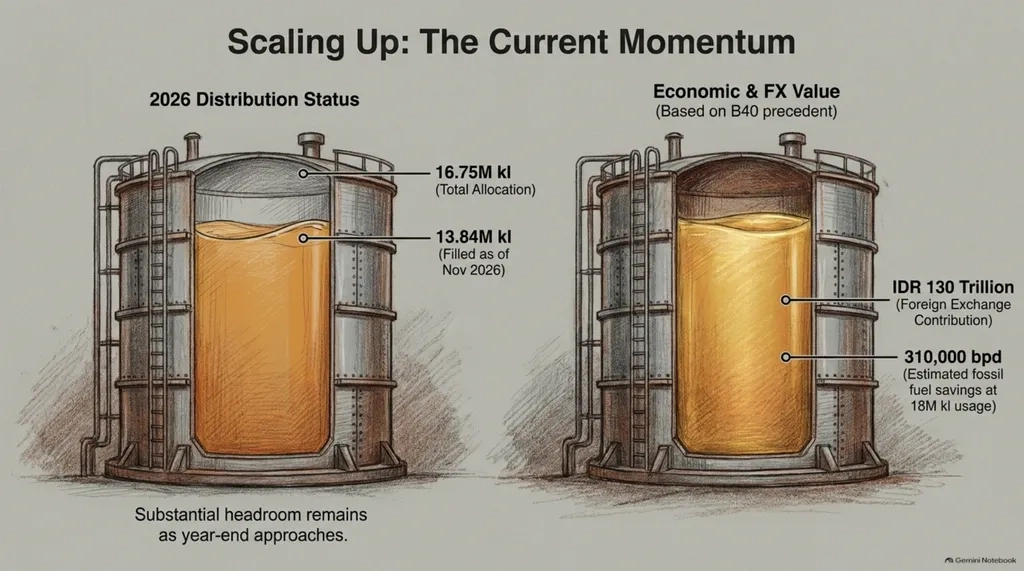
ESDM says its interim calculation shows enough feedstock to meet the program's needs through 2027, so exporters should be able to ship normally, according to JawaPos. Industry groups remain concerned that biodiesel will absorb palm oil that would otherwise be sold abroad, a worry the ministry has acknowledged.
Economist Achmad Nur Hidayat of UPN Veteran Jakarta has run a simulation for 2027 to 2030. As Kontan reported, a fixed B50 mandate could avoid up to 46.82 million kl of diesel imports over that period. The same fixed mandate could hold palm oil exports near 26.16 million tons in 2030. The articles reviewed do not publish his assumptions on production, prices or demand, so the figures work as one scenario rather than a forecast.
Why the incentive bill is the harder constraint
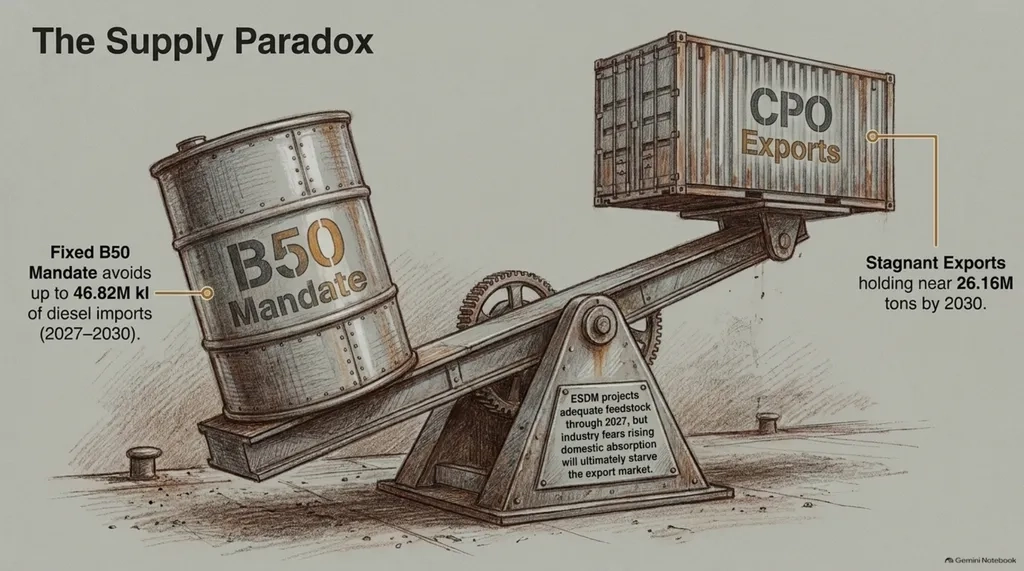
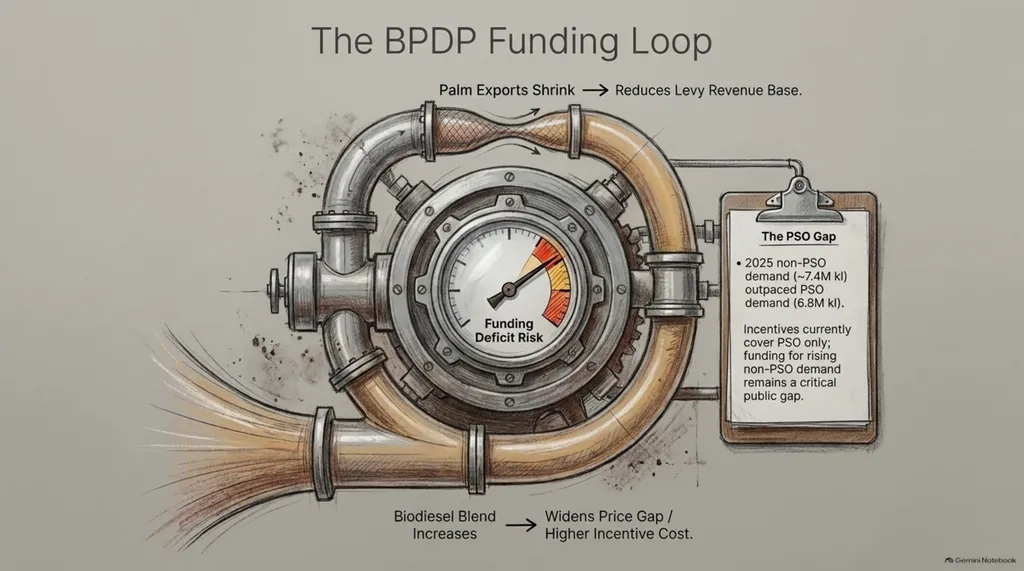
Biodiesel incentives are paid by the Plantation Fund Management Agency (BPDP) from export levies. ESDM projected the 2026 B40 incentive at about IDR 51 trillion, in line with the 2025 allocation, Kontan reported in January. That plan split 15.65 million kl into 7.45 million kl for public service obligation (PSO) use and 8.19 million kl for non-PSO use.
Eniya said in Bali that the incentive currently covers PSO use only, while non-PSO demand keeps rising. Non-PSO volumes were already larger in 2025, at about 7.4 million kl against 6.8 million kl for PSO. The sources do not explain how the non-PSO segment is priced or funded, which is a gap in the public picture.
Achmad's warning is arithmetic. If exports shrink, the levy base shrinks, while a larger blend widens the price gap the levy has to cover. Under a rigid mandate, he said, the BPDP fund would no longer cover the incentive and a funding deficit could follow. He proposed an adaptive B50 with fiscal and supply safeguards, as Sawit Indonesia reported.
What could prove the concern wrong
The export squeeze may not appear if feedstock supply grows or if domestic demand turns out lower than the allocation implies. Distribution of 13.84 million kl against a 16.75 million kl allocation shows some headroom in 2026. Palm oil prices also matter, because the incentive gap depends on the spread between biodiesel and fossil diesel, and a narrower spread would shrink the bill. The simulation itself rests on a fixed mandate, and a flexible one is exactly the change its author recommends.
What the 2027 decision will settle
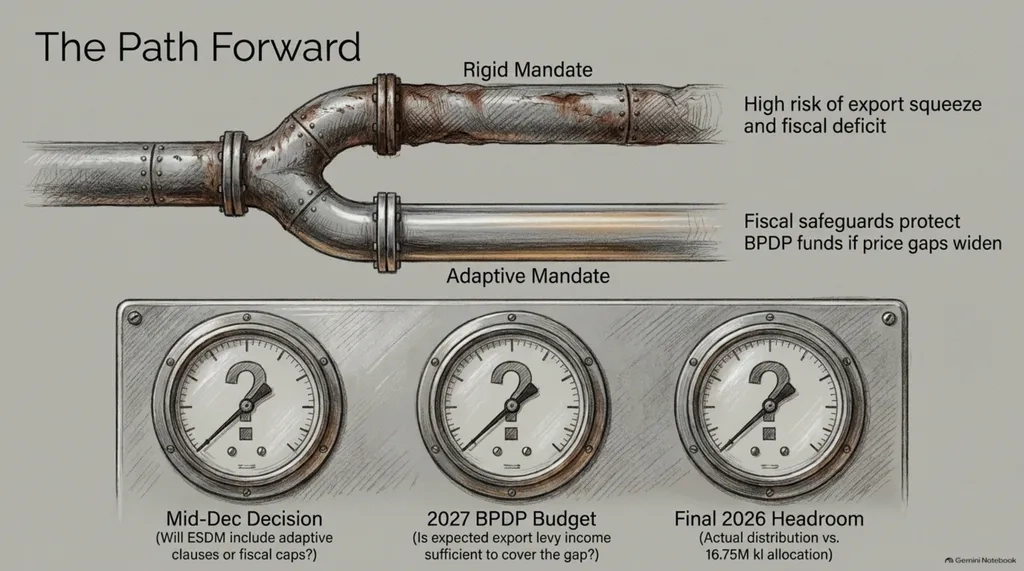
The evidence supports a narrow conclusion. ESDM sees adequate feedstock through 2027, an outside economist sees a squeeze on exports and levy funds under a rigid mandate, and the incentive design for non-PSO demand is not described in the sources reviewed. At the time of writing, no final 2027 blend had been published. Eniya's one-month remark points to a decision window around mid-December, though no date has been given.
What to watch: (1) the ESDM decision on the 2027 blend and any adaptive clause or fiscal cap, since a flexible mandate would address the funding concern directly. (2) The BPDP committee's 2027 incentive budget, because it shows whether levy income is expected to cover the gap. (3) Final 2026 biodiesel distribution against the allocation, which will show how much headroom exists.
References & resources:
- JawaPos: ESDM Segera Evaluasi B50, Pastikan Ekspor Sawit Tak Terganggu (13 November 2026)
- Kontan: Pemerintah Hitung Ulang Risiko Penerapan Mandatori B50 pada 2027
- Sawit Indonesia: Mandatori B50 2027 Dievaluasi
- CNBC Indonesia: 10,69 juta kl BBM baru B50 sudah tersalurkan (8 September 2026)
- Kontan: Penyaluran B50 Capai 3,4 Juta Kiloliter hingga 7 September 2026
- Kontan: ESDM Proyeksikan Insentif Biodiesel B40 2026 Rp 51 Triliun (7 January 2026)
- ESDM: Pemerintah Tetapkan Alokasi Biodiesel Tahun 2026 sebesar 15,65 juta kL
- CNBC Indonesia: Program Biodiesel 40% B40 Berhasil Dongkrak Devisa Rp130 Triliun (5 February 2026)