
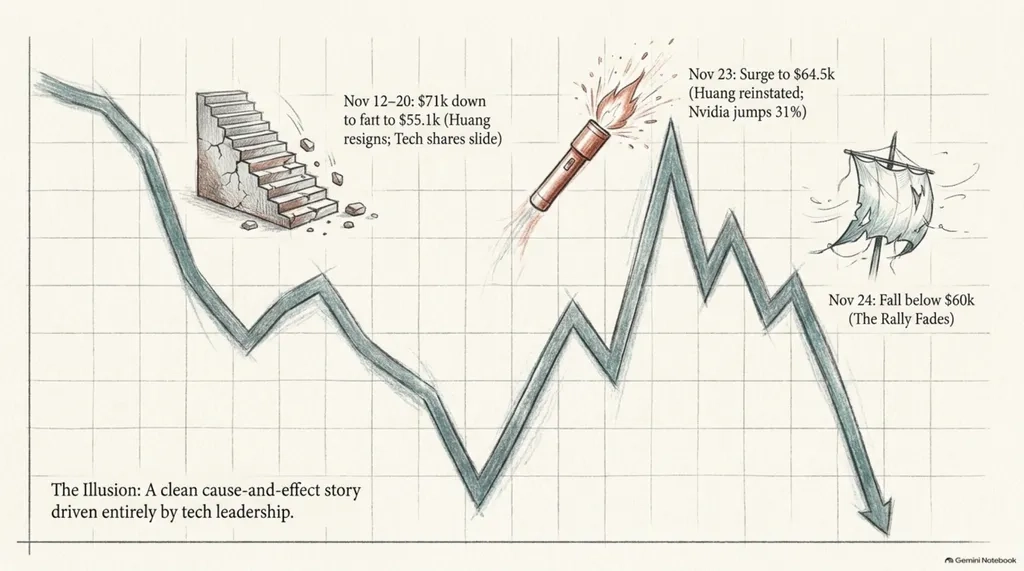
Bitcoin (BTC) fell below $60,000 on Tuesday, 24 November 2026, and was quoted at $60,002.89 in CoinDesk's report. That gave back most of Monday's jump, when the price came close to $64,000 after Nvidia reinstated Jensen Huang as chief executive. The Block put Monday's intraday high at $64,500 and the late-Monday low at $59,603.
The reversal matters because the rally looked like a clean cause and effect story: a leadership shock at the world's most watched AI company, then a relief move across tech and crypto. A day later, the relief had mostly gone. What remains is the question of which pressures on bitcoin were never about Nvidia in the first place.
What happened between the resignation and the reinstatement
Huang resigned as Nvidia's president, CEO and board member on 12 November, according to FXStreet. Cointelegraph reported that bitcoin fell toward $71,000 that day, its lowest level since 20 August, as tech shares slid. By Friday 20 November, Reuters reported (via The Star) that bitcoin dropped below $60,000 for the first time since July, with valuation worries weighing on the AI trade and other risk assets. Decrypt reports the price reached roughly $55,100 that night.

On Monday 23 November, the board reversed course. Decrypt noted that on 17 November the board chair had said directors did not intend to bring Huang back. Nvidia's stock then rose as much as 31% on Monday, according to CoinDesk, and the Nasdaq 100 gained 7%. Decrypt, using a slightly different measure, reported a gain of nearly 35% to about $170 per share. The sources differ because they sample different moments in a very fast session, so treat the exact peak as approximate.
Bitcoin followed the stock move up. By Tuesday, CoinDesk reported that Nasdaq 100 futures were down about 1% and Nvidia was 4.9% lower before the US open. Bitcoin fell more than 2% over 24 hours.
Why bitcoin followed Nvidia in both directions
Bitcoin does not own Nvidia's earnings or depend on its chips. The link runs through investor behavior. When money leaves AI-linked stocks, it tends to leave other risk assets at the same time, and crypto is often one of the quickest places to sell because it trades around the clock. The reverse also holds: a sudden buying wave in tech can pull in traders who hold both.
CoinDesk's report shows the same pattern in smaller names. AI infrastructure stocks Cipher Digital (CIFR), CoreWeave (CRWV) and TeraWulf (WULF) posted double-digit gains on Monday and were down roughly 3% to 4% in premarket trading on Tuesday. Anthropic's shares (ANT) fell 4% on Tuesday, after a 2% decline on Monday, and were recently priced around $84, just above the $83 IPO value, CoinDesk reported.
Prediction markets showed how much of the move was about sentiment. Decrypt reported that Polymarket's odds of an AI bubble bursting rose above 70% after Huang's exit and fell to 14% minutes after his reinstatement. A fall in perceived bubble risk helps explain a fast rally. It does not show that anything in the funding picture for AI or crypto had changed.
The headwinds that did not change
Analysts quoted by The Block called Monday's move a reflex rally. Min Jung of Presto Research said it squeezed short sellers for a few hours and then faded, because the news only fixed a leadership problem at Nvidia. Jung listed the real weights on bitcoin as a strong dollar, hawkish rate pricing and steady ETF outflows. Dominick John of Zeus Research described the rally as short covering that met overhead supply, and said the failure to hold the higher levels points to weak spot demand.

Some of these pressures are visible in other markets:
- The US Dollar Index held above 104 on Tuesday, its highest level since March 2025, per CoinDesk. A stronger dollar tends to tighten financial conditions for assets priced in dollars.
- Gold retreated to $3,622 an ounce after touching $3,690, and WTI crude traded near $80 a barrel with Brent below $87, according to the same report.
- US spot bitcoin ETFs recorded nearly $1.79 billion in net outflows last week, the largest weekly withdrawal since June, The Block reported.
ETF flows matter because these funds are a direct channel between traditional brokerage accounts and bitcoin. Persistent net redemptions mean fund managers sell bitcoin to meet withdrawals. The relationship between flows and price is not fixed, however, and flows often follow price as much as they lead it.
Two ways the next weeks could read
One reading says the market is still working through a risk-off phase. Zeus Research's John warned that a sustained break below $60,000 could open a path toward $58,000 and the recent low near $55,000. ViaBTC's Jeff Ko pointed to the Federal Reserve: he said a 25 basis point rate hike in December was almost fully priced in, and that the market would be sensitive to anything bringing a 50 basis point hike back into discussion.

The other reading says the selloff has already absorbed a lot of bad news. John noted that reclaiming the $62,000 to $64,000 zone would improve the near-term outlook. That would need buyers to hold ground that failed on Monday, which the short-covering explanation suggests is not guaranteed.
Neither reading is established by the evidence so far. One day of price action cannot separate a fading short squeeze from the start of a new low, and the causes the analysts cite are plausible mechanisms rather than proven drivers. The price levels above are analysts' reference points, not forecasts this publication endorses.
What the next data could clarify
The record so far shows a two-week swing, from about $71,000 on 12 November to roughly $55,100 on 20 November, then up to $64,500 and back near $60,000. Nvidia's own news explains the timing of the jumps. It explains far less about why the price could not hold, and the dollar, rate pricing and ETF outflows described above are the better candidates.
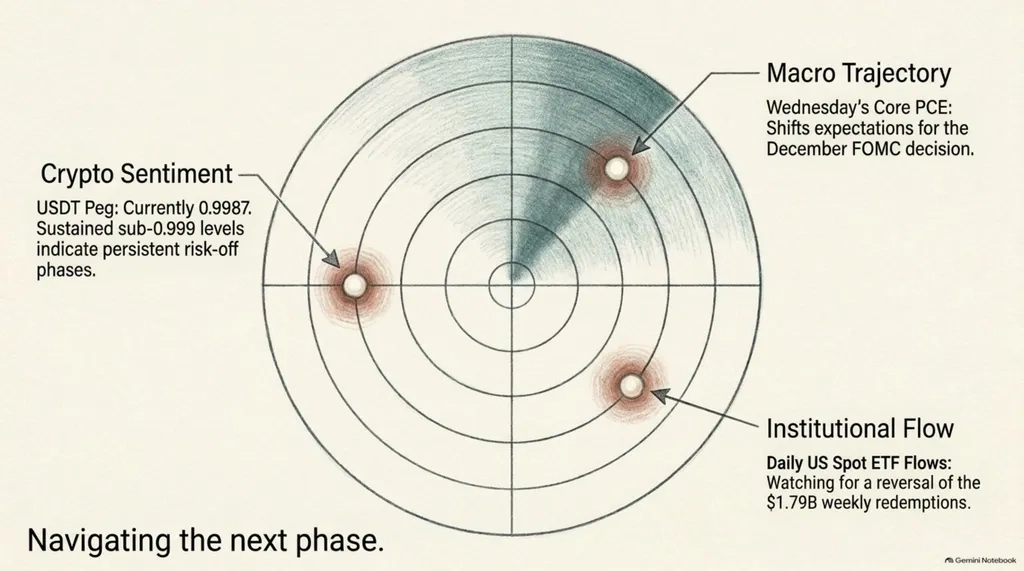
What to watch: Wednesday's core Personal Consumption Expenditures (PCE) inflation data, which The Block flagged as a focus for traders, and how it shifts expectations for the December Federal Open Market Committee decision. Daily US spot bitcoin ETF flows, to see whether the weekly outflow of nearly $1.79 billion reverses. And the stablecoin USDT, which Ko noted was trading around 0.9987, below the 0.999 level that has marked risk-off phases before.
References & resources:
- CoinDesk: Bitcoin falls below $60,000 as rally on Jensen Huang's Nvidia return fades (24 Nov 2026)
- The Block: Bitcoin slips back toward $60,000 as Jensen Huang's Nvidia return rally fizzles (24 Nov 2026)
- The Block: Bitcoin, crypto and tech stocks rally as Nvidia reinstates Jensen Huang as CEO (23 Nov 2026)
- Decrypt: Bitcoin rallies, Anthropic sinks as Nvidia surges on Jensen Huang's return
- Reuters via The Star: Bitcoin falls below $60,000 level (20 Nov 2026)
- Cointelegraph: Bitcoin slides toward $71K as Nvidia stock tumbles after Huang steps down (12 Nov 2026)
- FXStreet: Bitcoin, crypto market extend losses following Jensen Huang's resignation (12 Nov 2026)