
PT Adhi Karya (ADHI) reported profit attributable to owners of IDR 15.34 billion for the first nine months of 2026, up from IDR 4.42 billion a year earlier. Revenue fell to IDR 5.37 trillion from IDR 5.65 trillion, and operating cash flow swung to negative IDR 475.12 billion from positive IDR 328.75 billion (Katadata, 26 October 2026).
PT PP (PTPP) showed a similar pattern over the same period: attributable profit of IDR 259.96 billion against IDR 5.55 billion, lower revenue, and IDR 2.62 trillion of cash used in operations (Katadata, 26 October 2026). Both headlines are accurate, yet neither tells readers whether customers actually paid. The figures in this article come from press reports of the filings, so anyone who wants to verify them should open the original statements on the Indonesia Stock Exchange (IDX) website.
Profit and cash flow at three issuers, January to September 2026
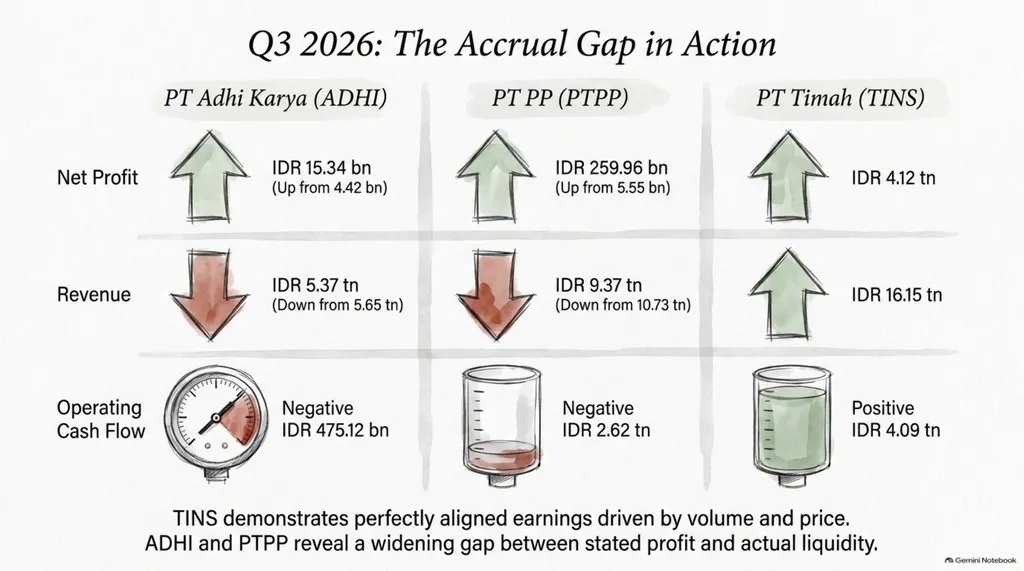
The table shows cumulative figures for the nine months to 30 September 2026, with the same period of 2025 in brackets. PT Timah (TINS) is included because its profit and cash moved in the same direction.
| Issuer | Net profit | Revenue | Operating cash flow |
|---|---|---|---|
| ADHI | IDR 15.34 bn (was 4.42 bn) | IDR 5.37 tn (was 5.65 tn) | Negative IDR 475.12 bn (was positive 328.75 bn) |
| PTPP | IDR 259.96 bn (was 5.55 bn) | IDR 9.37 tn (was 10.73 tn) | Negative IDR 2.62 tn (was negative 656.37 bn) |
| TINS | IDR 4.12 tn (was 602.42 bn) | IDR 16.15 tn (was 6.61 tn) | Positive IDR 4.09 tn (was negative 388.64 bn) |
ADHI and PTPP profit is the share attributable to owners of the parent, while the cash flow line covers the whole group. Sources: Katadata (ADHI and PTPP), ANTARA and Bisnis.com (TINS).
TINS reported net profit of IDR 4.12 trillion, and its operating cash flow turned positive at IDR 4.09 trillion (ANTARA, 30 October 2026). The company's disclosure tied the profit increase to higher sales volume and a higher average selling price for tin metal: 16,304 metric tons sold, up 72%, at an average of US$51,011 per ton, up 52% (Kabar Bursa, on the company's disclosure). At TINS, the profit on the income statement and the cash that arrived tell the same story.
What operating cash flow measures
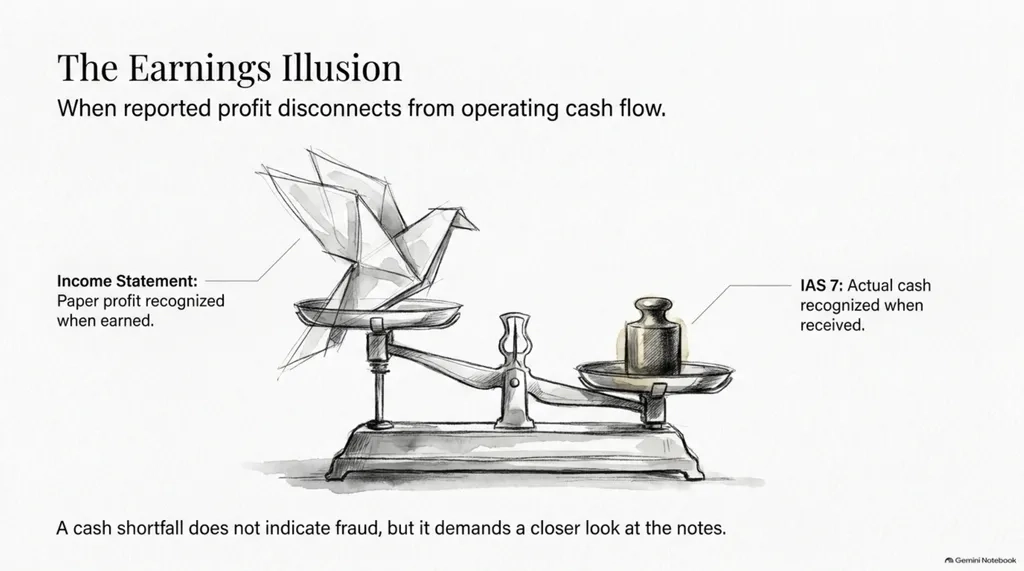
IAS 7, the international standard for cash flow statements, defines operating activities as the main revenue-producing activities of a company. Operating cash flow therefore includes cash received from customers and cash paid to suppliers and employees (IAS Plus summary of IAS 7). Under the indirect method, which the standard allows, the statement starts from profit and adjusts it to reach that figure (IFRS Foundation). Indonesian filings label the line "arus kas neto diperoleh dari (digunakan untuk) aktivitas operasi", meaning net cash provided by (used in) operating activities.
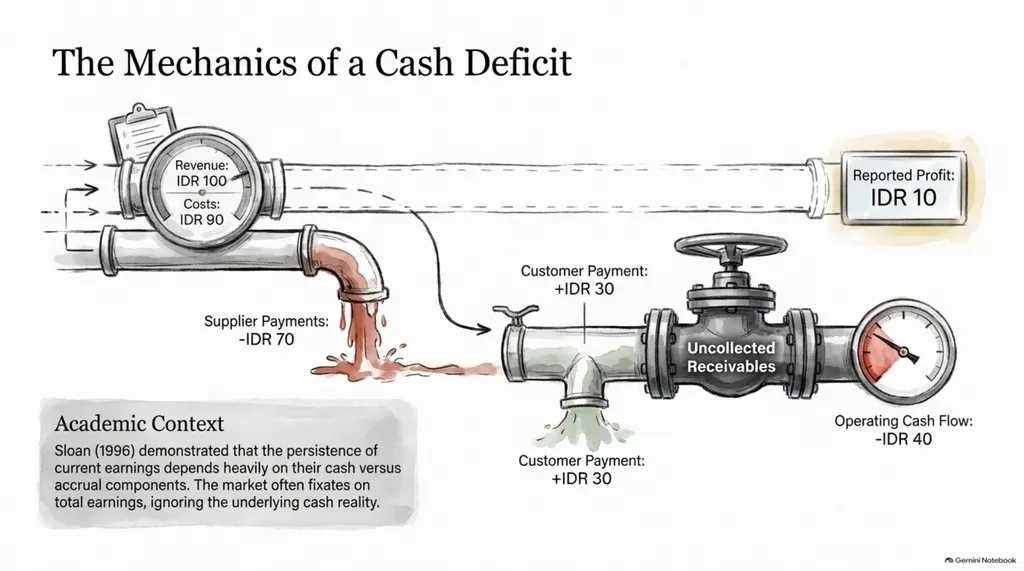
Profit follows accrual accounting, so revenue counts when it is earned, not when the money arrives. A hypothetical example, not market data: a contractor books IDR 100 of revenue and IDR 90 of costs, so profit is IDR 10. By the end of the period the customer has paid IDR 30, while the contractor has already paid suppliers IDR 70. Operating cash flow is negative IDR 40 even though the income statement shows a profit.
Academic research gives this gap some weight. Richard Sloan's 1996 paper in The Accounting Review found that how well current earnings persist into the future depends on the relative size of their cash and accrual components. It also found that stock prices acted as if investors fixated on total earnings (Sloan, 1996). A 2011 study in Management Science by Jeremiah Green, John Hand and Mark Soliman found that the trading returns from the accrual pattern had decayed in US markets until they were no longer reliably positive, partly because hedge funds put more capital into it. Both studies look at US stocks and neither tests Indonesian issuers.
Why profit and cash drift apart at ADHI and PTPP
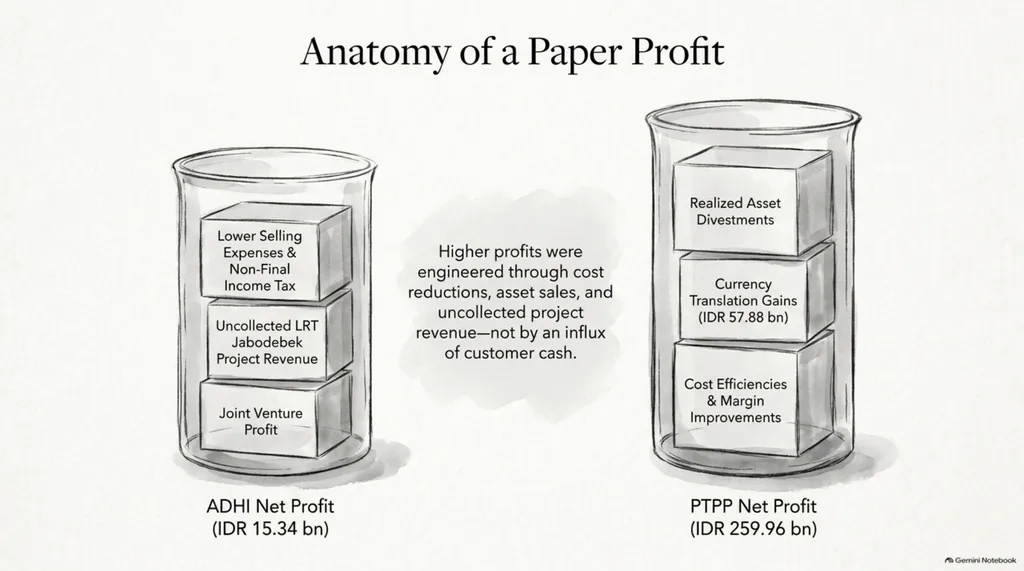
At ADHI, the lines that rose or fell help explain the profit. Selling expenses dropped to IDR 6.75 billion from IDR 8.9 billion, and non-final income tax expense fell to IDR 4.93 billion from IDR 9.07 billion (Katadata, 26 October 2026). The company's corporate secretary, Siswanto, said profitability improved through cost efficiency, recognition of revenue on the LRT Jabodebek project that the company labels IDP, and higher profit from joint ventures (Kontan, 28 October 2026). Lower costs and lower tax raise profit without bringing in a rupiah from customers, and revenue recognized on a project lifts profit before the client pays.
The cash side had shown strain earlier in the year. In July, management said it was working to collect on large projects such as LRT Jabodebek and the Aceh to Sigli toll road, because cash receipts were not yet optimal and this affected its ability to pay bond interest (Kontan, 29 July 2026). One analyst quoted by Kontan on 27 July 2026 pointed to weaker operating cash flow and a request to defer bond interest payments. ADHI's operating cash outflow was about IDR 751 billion at the half-year mark, and its cash balance had fallen to IDR 813.09 billion at 30 June from IDR 1.71 trillion at the end of 2025 (Kabar Bursa).
PTPP's profit rose while its gross profit fell 27.61% to IDR 1.16 trillion from IDR 1.61 trillion (Kontan, 22 October 2026). A currency translation gain grew to IDR 57.88 billion from IDR 25.94 billion, which is small beside IDR 259.96 billion of profit (Katadata). Kontan reported that realized asset divestments were one factor behind the increase, though the size of the gain is not stated in the part of the article available without a subscription (Kontan, 12 November 2026). Ardy Irianto Subekti, an equity analyst at Indo Premier Sekuritas, said the improvement at state-owned contractors came mostly from cost efficiency, better margins and non-operating items, with little help from revenue growth (Kontan, 9 November 2026).
A different reading is possible. Construction cash flow swings with project timing, and negative operating cash flow can reverse once receivables are collected. ADHI's own figure was positive a year earlier, and its outflow of IDR 475.12 billion at nine months is smaller than the roughly IDR 751 billion at six months. That implies operating cash flow of about IDR 276 billion in the third quarter alone, an estimate based on two press reports and a rounded half-year figure. Against that, PTPP's outflow widened from IDR 656.37 billion to IDR 2.62 trillion.
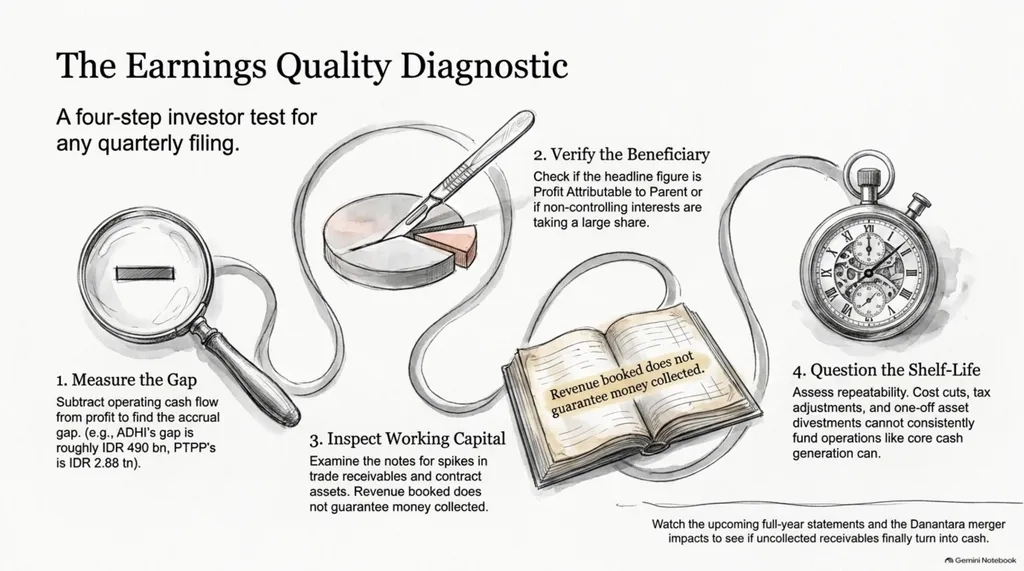
A four-step test for any quarterly filing
- Compare profit with operating cash flow for the same period. Subtracting the cash flow from profit gives a rough accrual gap: about IDR 490 billion at ADHI, about IDR 2.88 trillion at PTPP and about IDR 30 billion at TINS, within rounding. Researchers usually scale this gap by assets. When profit is tiny, a ratio between the two numbers becomes meaningless, so the rupiah amounts are more useful.
- Check which profit line a headline uses. Profit attributable to the parent can differ a lot from profit for the period. At PTPP in the first nine months of 2025, profit for the period was IDR 15.24 billion, but only IDR 5.55 billion belonged to the parent because non-controlling interests took IDR 9.68 billion (Bisnis.com, 27 October 2025).
- Read the working-capital lines in the notes: trade receivables, contract assets, inventories and trade payables. PT Indah Prakasa Sentosa (INPS) reported profit of IDR 14.65 billion, up 417.7%, and operating cash flow of negative IDR 4.83 billion against positive IDR 11.26 billion. The company linked the swing partly to a IDR 15.13 billion increase in third-party trade receivables, mainly from its fuel agency business (Kontan, 30 October 2026). Rising receivables explain a cash gap without settling whether the money will be collected.
- Ask what produced the profit and whether it can repeat. Cost cuts, a lower tax charge, currency translation, joint venture income and asset sales each have a different shelf life. Operating profit backed by cash tends to repeat more reliably than a divestment gain.
What the gap can and cannot show
In the nine-month data, ADHI and PTPP both reported higher profit with lower revenue and weaker operating cash flow, and the explanations given point to costs, tax, joint ventures and divestments, not to collections. TINS shows the opposite case, where higher volumes and prices produced profit and cash together. A cash shortfall is a prompt to read the notes and says little about whether a company's accounts are reliable.
This analysis does not establish whether ADHI or PTPP will collect what customers owe, how large PTPP's divestment gain was, or whether the third-quarter improvement at ADHI will hold. The first two need the original filings, and the third needs another quarter of data.
What to watch: The full-year 2026 statements from ADHI and PTPP, once published, will show whether annual operating cash flow turns positive and what the receivables and contract asset lines contain. Danantara targeted completion of the ADHI and PTPP merger by the end of November 2026, though Kontan reported on 9 November that the schedule had slipped several times, so any merger disclosure on combined receivables and debt matters. ADHI's collections from LRT Jabodebek, which management named as a priority, should appear in its receivables and cash flow lines in the next filing.
References & resources:
- Katadata: Menilik Kinerja ADHI, PTPP, WSKT Kuartal III Menjelang Merger BUMN Karya (26 October 2026)
- Kontan: Melihat Kinerja Emiten Konstruksi per Kuartal III di Tengah Tantangan Arus Kas (9 November 2026)
- Kontan: Adhi bidik tambahan kontrak baru pada kuartal IV 2026 (28 October 2026)
- Kontan: Ini Penjelasan Adhi Karya (ADHI) Soal Beda Arah Pendapatan dan Laba Semester I 2026 (29 July 2026)
- Kontan: Simak Prospek Kinerja Adhi Karya (ADHI) di Tengah Penurunan Pendapatan dan Arus Kas (27 July 2026)
- Kabar Bursa: Danantara Pangkas Anak Usaha Adhi Karya, Fokus Jadi Kontraktor
- Kontan: Laba PT PP (PTPP) Naik Meski Pendapatan Turun per Kuartal III 2026 (22 October 2026)
- Kontan Insight: Divestasi Aset Dongkrak Profitabilitas PTPP (12 November 2026)
- Bisnis.com: Laba Bersih BUMN Karya PTPP Merosot Tajam, Raih Rp5,55 Miliar per Kuartal III/2025 (27 October 2025)
- ANTARA: PT Timah raih laba bersih Rp4,12 triliun (30 October 2026)
- Bisnis.com: Laba 9 Bulan Rekor, Timah (TINS) Kejar Target Produksi 25.000 Ton (17 November 2026)
- Kabar Bursa: TINS Raup Laba Bersih Rp4,12 Triliun di Kuartal III 2026
- Kontan: Laba Indah Prakasa (INPS) Melonjak 417,7% pada Kuartal III-2026 (30 October 2026)
- IAS Plus: IAS 7 Statement of Cash Flows
- IFRS Foundation: IAS 7 Statement of Cash Flows
- Sloan (1996), Do Stock Prices Fully Reflect Information in Accruals and Cash Flows about Future Earnings?, The Accounting Review
- Green, Hand and Soliman (2011), Going, Going, Gone? The Apparent Demise of the Accruals Anomaly, Management Science